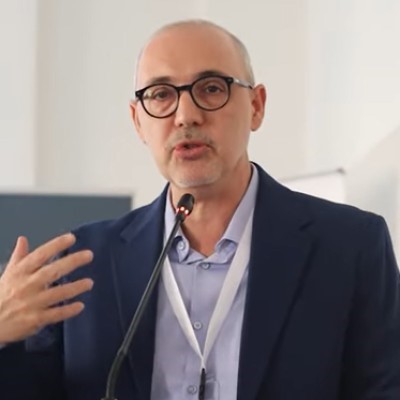
Karim Bouzoubaa is a Full Professor of Artificial Intelligence and Data Science at Mohammed V University in Rabat, and a leading expert in natural language processing (NLP), multilingual AI, and intelligent systems. With more than two decades of experience spanning academia, research, and industry, he combines scientific excellence with strategic leadership to advance AI innovation at both national and international levels.
He is the founder and head of the Language Engineering and Learning Modelling (ALELM) research lab, a pioneering center established in 2006 that has contributed significantly to the advancement of Arabic language technologies. His research spans machine learning, deep learning, large language models (LLMs), multi-agent systems, and computational linguistics, with a particular focus on low-resource languages and Arabic NLP.
Professor Bouzoubaa has led and co-led numerous high-impact R&D projects, including the SAFAR framework—one of the leading platforms for Arabic NLP—and major initiatives such as the MURABAA platform for Arabic linguistic knowledge digitization and the AI and Mobility Chair for the Moroccan railway industry. His work has resulted in widely used linguistic resources and tools distributed through international platforms such as CLARIN, ELRA, and LDC.
A prolific researcher, he has authored over 120 publications in top-tier journals and conferences, alongside several books in programming and software engineering. His contributions have been recognized with multiple awards, including distinctions from Google and NVIDIA.
Beyond academia, he is an active contributor to the AI ecosystem, co-founding an AI startup specialized in multilingual NLP solutions for sectors such as FinTech. He also serves as a consultant, executive educator, keynote speaker, and advisor on AI strategy and policy, including the proposal for establishing a Moroccan National Centre for AI and Language Technologies.
Internationally engaged, Professor Bouzoubaa has held visiting and adjunct positions across Europe and North America (including the UK, USA, and Canada), and regularly delivers keynote talks on topics such as generative AI, AI ethics, and language technologies. His work bridges cultures and disciplines, leveraging his dual exposure to Arabic-African and Western academic systems to promote inclusive and impactful AI innovation.
Artificial Intelligence has been built on decades of progress in language technologies. From search engines and machine translation to conversational assistants and large language models, language has become the driving force behind some of the world’s most influential technology companies and AI breakthroughs. Yet the AI revolution is unfolding unevenly across languages. While a small number of languages benefit from vast amounts of digital content, investment, and technological support, many others remain underrepresented or even digitally invisible, placing at risk not only linguistic diversity but also the cultures, knowledge, and identities they embody. Drawing on more than three decades of experience in multilingual AI, Arabic language technologies, industrial innovation, and AI policy, this keynote explores how languages can be understood according to their level of digital maturity. The talk argues that successful AI development must begin with a deep understanding of the language itself and should combine appropriate technologies, together with sustained efforts to create content, linguistic resources, and knowledge infrastructures. Through examples from international initiatives, Arabic language technologies, and emerging AI ecosystems, the keynote highlights how countries and organizations can build language-aware AI strategies that promote innovation, digital sovereignty, and cultural preservation. Ultimately, it makes the case that ensuring no language is left behind is not merely a technological challenge but a societal responsibility that will shape the future of AI and, more broadly, the future of humanity.